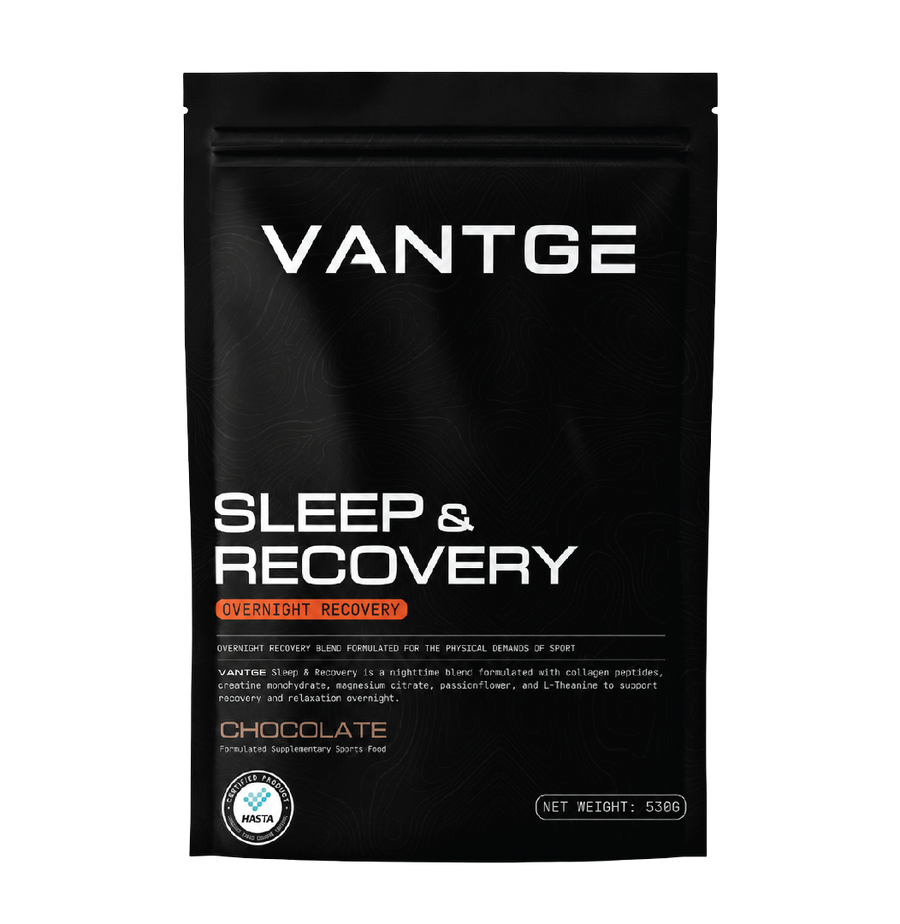
SLEEP & RECOVERY

Sleep & Recovery is formulated for the overnight window - the hours when your body does its most critical repair work. Every ingredient targets a specific physiological process: structural tissue repair, sleep quality and onset, anti-inflammatory management, and immune function. This page explains what each ingredient does, what the research supports, and why we chose each one.

STRUCTURAL REPAIR

The rationale

Connective tissue - tendons, ligaments, joint capsules, and the intramuscular connective tissue that transmits force - is under enormous stress during sport. Unlike muscle, which adapts relatively quickly to training, connective tissue has a slower turnover rate and limited blood supply. It is the structure most likely to break down under repeated high intensity competition loads and the slowest to rebuild.

Sleep & Recovery addresses this through a combination of Hydrolysed Bovine Collagen Peptides and Creatine Monohydrate - two of the most studied ingredients in sports recovery nutrition.

Hydrolysed Bovine Collagen Peptides

15,000 mg
What it is
Hydrolysed Bovine Collagen Peptides are short-chain amino acid sequences derived from bovine collagen, broken down through hydrolysis into fragments small enough for rapid intestinal absorption. Unlike whole protein collagen, hydrolysed peptides are specifically absorbed and transported to connective tissues, where they stimulate fibroblast activity and promote new collagen synthesis.
What the research shows
A systematic review of 15 randomised controlled trials (PMC8521576) confirmed that collagen peptide supplementation combined with exercise is most beneficial for improving joint functionality and reducing joint pain. Critically, the review found that collagen synthesis rates were elevated specifically with 15g/day of collagen peptides - a dose-specific finding that underpins our formulation decision. Research published in APNM (2017, Canadian Journal of Applied Physiology) demonstrated that vitamin C-enriched gelatin (a collagen precursor) taken 1 hour before exercise increased collagen synthesis markers in blood and improved the mechanical properties of engineered ligaments - confirming the synergistic relationship between collagen and Vitamin C that is reflected in our formula. A 2023 study in the American Journal of Clinical Nutrition found that 15g of collagen peptides daily, combined with strength training, increased tendon cross-sectional area compared to placebo after 12 weeks. Research on CP supplementation and connective tissue repair (Frontiers in Nutrition, 2023) confirmed that specific collagen peptides stimulate collagen synthesis in connective tissue- an effect not replicated by other protein sources including whey and essential amino acids, which do not significantly increase connective tissue matrix synthesis rates.
Why it's in Sleep & Recovery:
At 15,000 mg per serve, Sleep & Recovery delivers the clinically evidenced dose for elevating collagen synthesis rates. The overnight window is the optimal time for this - the body is in a fasting, repair state and collagen peptides consumed before sleep are available for connective tissue remodelling during the growth hormone release that occurs in deep sleep phases. Vitamin C is included in the same formula to support collagen synthesis.
References

Creatine Monohydrate

3,000 mg
What it is
Creatine monohydrate is the most extensively researched sports supplement in history. It works by increasing the intramuscular phosphocreatine (PCr) pool, enabling faster regeneration of ATP - the primary energy currency of high-intensity effort. Beyond energy metabolism, creatine also supports muscle protein synthesis, reduces exercise induced muscle damage, and accelerates recovery between sessions.
What the research shows
The evidence base for creatine monohydrate across multiple performance and recovery outcomes is exceptionally strong. Research published in PMC8228369 confirms that creatine supplementation increases muscle phosphocreatine stores, improves high-intensity exercise capacity, accelerates recovery, and reduces markers of exercise-induced muscle damage including creatine kinase and muscle soreness. A 2025 randomised, double-blind, placebo-controlled crossover trial (PMC12736258) specifically studying creatine monohydrate's effects on sleep metrics, physical performance, and cognitive function in athletes - found that a creatine loading protocol improved subjective sleep quality, enhanced cognitive performance, and increased output during high-intensity intermittent exercise. The study also found reduced muscle soreness. The researchers concluded that creatine offers benefits beyond its traditional ergogenic role, making it particularly relevant in a sleep and recovery context. A separate randomised controlled trial (PMC12157024) demonstrated that creatine monohydrate supplementation produced significantly quicker recovery of maximal voluntary contraction (MVC) following exercise-induced muscle damage compared to placebo, with reductions in muscle fatigue and stiffness. Research on creatine timing (PMC9708881) suggests that post-exercise creatine ingestion may be more effective than pre-exercise for lean tissue and strength gains - supporting the rationale for including creatine in a recovery formula rather than a pre-workout.
Why it's in Sleep & Recovery
The overnight window is an optimal time for creatine uptake. Muscles are in a repair and replenishment state. Including 3,000 mg of creatine monohydrate before sleep ensures consistent daily creatine saturation without requiring a separate supplement, and research now supports creatine's role in sleep quality and cognitive recovery - directly relevant to athletes under high training loads.
References

SLEEP QUALITY & NEUROMUSCULAR RESET

SLEEP QUALITY & NEUROMUSCULAR RESET
The rationale

Sleep is the most underutilised recovery tool in sport. The quality of sleep - not just the duration - determines the rate of tissue repair, the extent of growth hormone release, the clearance of metabolic waste products, and the restoration of cognitive function. Sleep & Recovery targets sleep quality through three complementary ingredients that support natural sleep physiology without synthetic sedation.

Magnesium Citrate

1,000 mg (172 mg elemental magnesium)
What it is
Magnesium Citrate is magnesium bound to citric acid, a well-absorbed and widely studied form of magnesium supplementation. Magnesium regulates GABA receptor function in the brain, modulates the HPA stress axis, and supports neuromuscular relaxation, all mechanisms directly relevant to sleep onset and quality.
What the research shows
A randomised controlled trial examining magnesium citrate supplementation at 400 mg elemental magnesium per day over 90 days found measurable improvements in sleep quality and cognitive function in adults with poor baseline sleep, using a twice-daily dosing protocol with the larger dose taken 1-2 hours before bed. Magnesium citrate has also been used in earlier sleep research, including Nielsen et al. (2010), which found improvements in sleep parameters using a 320 mg elemental magnesium dose. Broader research on magnesium and sleep consistently identifies elemental magnesium intakes in the 300-400 mg range as supportive of sleep quality and reduced sleep onset latency, with citrate forms recognised as both well-absorbed and cost effective for consistent daily use. Magnesium citrate is also commonly used among athletes specifically for its role in supporting muscle recovery and reducing exercise-related muscle tension, alongside its sleep-supporting properties.
Why it's in Sleep & Recovery
Magnesium Citrate provides 172 mg of elemental magnesium per serve, contributing toward the clinically studied range for sleep quality support. It is paired with L-Theanine and Passionflower Extract to address sleep onset and neuromuscular relaxation from multiple angles, while also supporting muscle recovery following high-intensity competition.
References

L-Theanine

300 mg
What it is
L-Theanine appears in both Complete Performance and Sleep & Recovery - but at different doses and for different purposes. In Complete Performance at 200 mg, it provides focused alertness. In Sleep & Recovery at 300 mg, it supports sleep onset and quality through its GABA-modulating and anxiety-reducing effects. The higher dose is consistent with research showing stronger sleep-related outcomes at doses of 250–400 mg.
What the research shows
L-Theanine's sleep-supporting effects are mediated through its ability to reduce physiological stress markers, modulate GABA and serotonin activity, and promote alpha-wave brain activity associated with relaxed, pre-sleep states. Research shows that 200 mg L-Theanine reduced subjective stress responses within one hour and significantly lowered cortisol levels within three hours of ingestion - creating the physiological conditions for sleep onset. Studies also confirm that L-Theanine improves sleep quality without causing daytime drowsiness (unlike many sleep aids), making it appropriate for athletes who cannot afford residual sedation the following morning. Recent research published in Sleep Medicine (2025, ScienceDirect PMC) confirmed that L-Theanine improves sleep quality metrics including sleep efficiency and subjective sleep satisfaction in individuals with sleep difficulties.
Why it's in Sleep & Recovery
At 300 mg, L-Theanine supports the transition to restful sleep by modulating the stress and arousal responses that competition and training elevate. It works synergistically with Magnesium Citrate and Passionflower Extract to create a comprehensive, non-sedating sleep quality stack.
References

Passionflower Extract

200 mg
What it is
Passionflower (Passiflora incarnata) is a botanical extract with a long history of use for anxiety and sleep support, backed by a growing body of clinical evidence. Its primary mechanism of action is GABA-A receptor modulation - the same receptor system targeted by many pharmaceutical sleep aids, but through a gentler, non-addictive mechanism that does not produce residual sedation.
What the research shows
Research published in PMC6977488 confirmed that Passionflower extract significantly improved total sleep time, sleep efficiency, sleep onset latency, and reduced wake time after sleep onset in a randomised, double-blind, place bocontrolled crossover trial. Notably, the extract improved subjective sleep quality without producing daytime impairment. A 2024 review (PMC11026993) of Passionflower's anxiolytic and sleep-supporting properties confirmed consistent evidence for its role in reducing pre-sleep anxiety and supporting sleep quality - outcomes that are particularly relevant to athletes whose elevated arousal levels after competition or intensive training impair sleep onset.
Why it's in Sleep & Recovery
200 mg of Passionflower Extract at a standardised potency supports sleep onset by modulating the GABA system and reducing pre-sleep anxiety without producing sedation or affecting next-day alertness. For athletes competing at night and attempting to sleep within 2–3 hours of high arousal, Passionflower provides meaningful physiological support for the transition to restful sleep.
References

ANTI-INFLAMMATORY

ANTI-INFLAMMATORY
The rationale

Repeated high-intensity sport creates systemic inflammation. Elevated C-reactive protein (CRP), elevated creatine kinase (CK), and inflammatory cytokine cascades are normal responses to tissue damage from competition. When inflammation is unmanaged across repeated competition cycles, it accumulates - increasing injury risk, slowing recovery, and impairing subsequent performance. Sleep & Recovery addresses this through Turmeric Extract (standardised for curcuminoids) paired with Piperine - the combination proven to overcome curcumin's notoriously poor bioavailability.

Turmeric Extract (CW050)

600 mg
What it is
Turmeric Extract standardised for curcuminoids is the concentrated form of the active polyphenol compounds found in Curcuma longa. Curcumin - the primary curcuminoid - is one of the most extensively researched anti-inflammatory compounds in natural medicine, with over 19,000 PubMed citations and more than 400 clinical trials across a range of inflammatory conditions.
What the research shows
Research directly relevant to sport recovery includes a study of turmeric supplementation in elite male footballers (PMC10244580) - one of the first studies in professional team sport athletes. Footballers taking a curcumin-containing supplement across eight competitive matches showed significantly attenuated C-reactive protein (CRP) compared to controls, along with reduced leg soreness and whole-body soreness postmatch. These findings are consistent with curcumin's known mechanisms: inhibition of NFκ B signalling (a key inflammatory pathway) and reduction of pro-inflammatory cytokines including TNFα and IL-6.
A double-blind crossover study in trained male runners (PMC9032800) examined curcumin + piperine on inflammatory cytokines following a running session to voluntary fatigue. Results showed meaningful attenuation of inflammatory mediators in the supplementation condition compared to placebo. Research on curcumin and muscle damage recovery (PubMed 28344463) in elite rugby players found that curcumin + piperine reduced sprint mean power output decline postexercise-induced muscle damage compared to placebo - suggesting a meaningful recoveryperformance benefit.
Why it's in Sleep & Recovery
At 600 mg, Turmeric Extract (CW050) provides a substantial curcuminoid load specifically formulated for systemic anti-inflammatory support in athletes under repeated competition demands. This is the dose range used in studies demonstrating performance-relevant anti-inflammatory outcomes in sport populations.
References

Piperine 95% (Black Pepper Extract)

5.5 mg
What it is
Piperine is the principal alkaloid of black pepper (Piper nigrum), responsible for its pungency. At a standardised 95% extract, it is included in Sleep & Recovery at 5.5 mg - a small dose with a disproportionately large effect on the bioavailability of curcumin
What the research shows
Piperine is a well-documented bioavailability enhancer. Research published by Johns Hopkins Medicine and confirmed across multiple pharmacokinetic studies demonstrates that piperine combined with curcumin increases curcumin bioavailability by up to 2,000% compared to curcumin taken alone. Without piperine, curcumin is poorly absorbed due to rapid metabolism and elimination in the gastrointestinal tract - making high-dose turmeric supplementation largely ineffective without a bioavailability-enhancing agent. The pharmacokinetics study by Shoba et al. (1998) - the original landmark research on this combination - confirmed the dramatically increased plasma curcumin concentrations when piperine was co-administered, with a long retention time and excellent safety profile.
Why it's in Sleep & Recovery
Without Piperine, the 600 mg of Turmeric Extract would be largely wasted. At 5.5 mg of 95% standardised Piperine, the combination ensures that the anti-inflammatory action of curcumin is actually absorbed and utilised. This is the dose used consistently across curcumin bioavailability research.
References

IMMUNE SUPPORT

The rationale

Athletes under heavy training loads face elevated immune suppression risk. Intense exercise transiently suppresses immune function - and when training blocks and competition schedules are dense, this suppression can become cumulative. Vitamin C and Zinc are two of the most studied immune-supporting micronutrients, included in Sleep & Recovery at doses aligned with the research.

Ascorbic Acid (Vitamin C)

80 mg
What it is
Vitamin C (ascorbic acid) is a water-soluble antioxidant essential for immune function, collagen synthesis, and protection against exercise-induced oxidative stress. It acts as both a direct free radical scavenger and a cofactor in enzymatic reactions critical to immune cell function.
What the research shows
Research confirms two key roles for Vitamin C in Sleep & Recovery's context. First, Vitamin C is a required cofactor in collagen synthesis specifically in the hydroxylation of proline and lysine residues that give collagen its structural integrity. Research (PMC7767325) demonstrates that Vitamin C deficiency directly impairs collagen formation, while supplementation supports collagen synthesis rates - making it a synergistic partner for the Hydrolysed Collagen Peptides in this formula. Second, Vitamin C supports immune function in athletes. Research in PMC7918462 confirms that Vitamin C supplementation reduces the duration and severity of upper respiratory tract infections in athletes under heavy training loads - a specific and clinically meaningful outcome for sport athletes who cannot afford illness during competition blocks.
Why it's in Sleep & Recovery
At 80 mg per serve, Vitamin C provides meaningful supplementation alongside the 15g collagen peptide dose - supporting the collagen synthesis process directly - while also contributing to immune resilience in athletes under training and competition stress.
References

Zinc Amino Acid Chelate

75 mg (12 mg elemental zinc)
What it is
Zinc Amino Acid Chelate is zinc bound to amino acids for enhanced bioavailability compared to inorganic zinc forms. Zinc is an essential trace mineral involved in over 300 enzymatic reactions, including those critical to immune function, protein synthesis, wound healing, and testosterone production.
What the research shows
Research confirms that zinc is consistently under-consumed by athletes - particularly those in endurance and team sports - and that zinc status directly impacts immune function. Research (Tandfonline 2021 review) demonstrates that zinc deficiency impairs immune cell development and function, increasing susceptibility to infection and impairing recovery from illness. Studies in athlete populations (PMC5748737) show that zinc supplementation in athletes with suboptimal zinc status improves immune markers and supports the recovery of immune function following heavy exercise. Research also confirms zinc's role in wound healing and tissue repair - consistent with the recovery-focused context of Sleep & Recovery.
Why it's in Sleep & Recovery
At 12 mg of elemental zinc per serve from the amino acid chelate form, Sleep & Recovery delivers a meaningful daily zinc contribution at a dose that supports immune function without exceeding safe upper intake levels. Combined with Vitamin C, it provides a complete immune support pairing for athletes managing high training and competition loads.
References
HASTA certified

All VANTGE products are HASTA (Human and Supplement Testing Australia) certified. Every batch is independently screened against the WADA prohibited list.