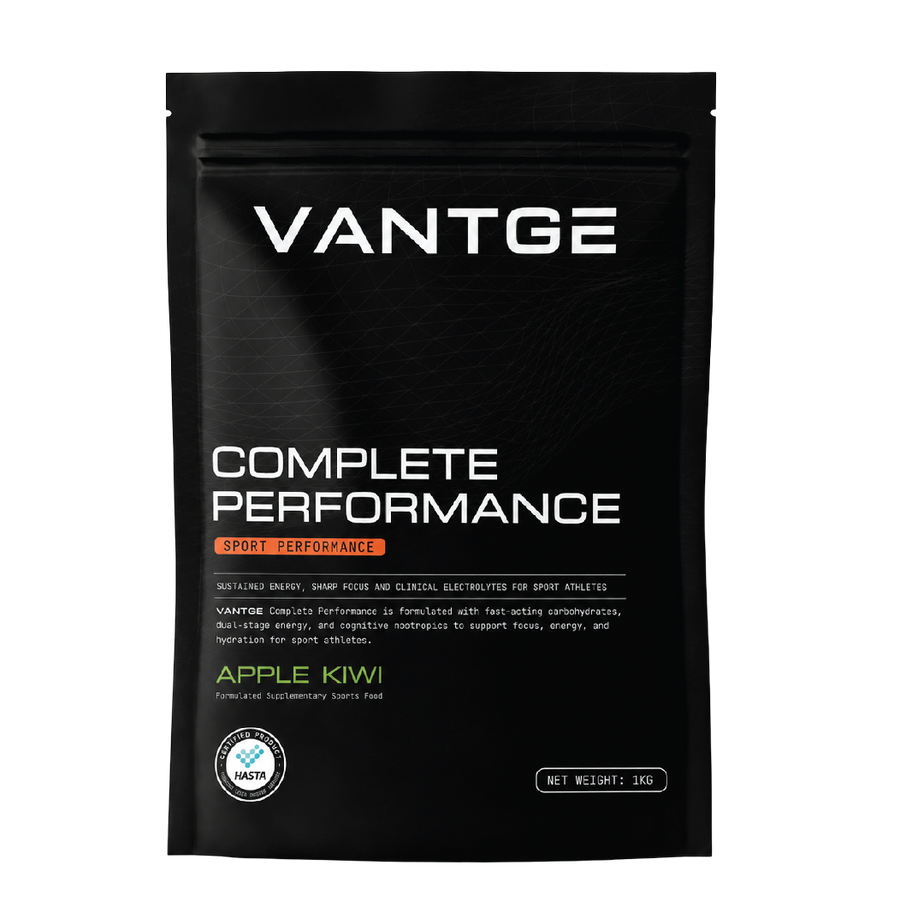
Complete Performance

Complete Performance is formulated for the demands of sport. Every ingredient is included because the research supports it at the dose we've used. This page explains what each ingredient does, what the evidence shows, and why we made the decisions we made.

Fuel

The rationale

Sport athletes running at high intensity deplete muscle glycogen faster than almost any other activity. When glycogen runs out, performance drops - not gradually, but sharply. The solution isn't just more carbohydrate. It's the right type of carbohydrate, dosed correctly, delivered without gastrointestinal stress. Complete Performance uses a dual-source carbohydrate system - Maltodextrin and Dextrose - based on research showing that combining carbohydrates which use different intestinal transporters leads to higher total carbohydrate oxidation rates than single-source formulas.

Maltodextrin

25,300 mg
What it is
Maltodextrin is a complex carbohydrate derived from starch, composed of short glucose polymer chains. It is rapidly absorbed through the SGLT1 intestinal transporter and converted to blood glucose, providing fast and sustained fuel for working muscles.
What the research shows
Carbohydrate ingestion during intense exercise has been studied for decades, and the results are consistent. Below and colleagues found trained cyclists completed a one-hour performance test 6.3% faster with carbohydrate on board compared to none, using maltodextrin as the source. Other research on trained cyclists found glucose polymer ingestion, the same category maltodextrin belongs to, extended time to exhaustion during high-intensity intervals from 174 minutes on placebo to 205 minutes with carbohydrate. The effect holds in team sport too. Studies on match-style exercise found carbohydrate ingestion reduced muscle glycogen depletion by 22% compared to placebo, helping explain why properly fuelled players sustain high-intensity running deep into the second half. One study recorded soccer players' output after a maltodextrin drink at halftime and found a clear benefit over placebo. Complete Performance is built on maltodextrin for exactly this reason. It's the same carbohydrate source that shows up again and again in the research behind sustained output, whether that's the final twenty minutes of a match or the back half of a long session.
Why it's in Complete Performance
Maltodextrin provides the primary fuel substrate. At 25.3g per serve it delivers a rapid, sustained glucose supply for high-intensity sport performance without the gastrointestinal burden associated with single high-fructose formulas.
References
  • https://pubmed.ncbi.nlm.nih.gov/7723643/
  • https://pubmed.ncbi.nlm.nih.gov/2927302/
  • https://pmc.ncbi.nlm.nih.gov/articles/PMC4517026/

Dextrose (Dextrose Anhydrous)

15,000 mg
What it is
Dextrose is glucose in its simplest monosaccharide form. It is absorbed directly through the SGLT1 transporter and enters the bloodstream faster than any other carbohydrate source, providing an immediate fuel spike to working muscles and the brain.
What the research shows
Glucose research tells a consistent story about speed. One study on pre-exercise glucose ingestion found blood glucose levels were 55% higher at the start of exercise compared to a placebo trial, giving the body immediate fuel to draw on rather than waiting on it to arrive. That rapid availability translates to output. A study on soccer players found a 10% dextrose drink outperformed a comparison drink at raising blood glucose and improving sprint speed during match-simulated conditions, direct evidence that fast-absorbing glucose supports repeated high-intensity efforts, not just steady-state endurance. The endurance case holds too. A trial on glucose ingestion before exercise in hypoxic conditions found endurance capacity improved by 31% compared to placebo, with glucose alone producing gains nearly matching those seen with caffeine. Complete Performance uses dextrose for exactly this reason. It's the fastest-absorbing carbohydrate available, built to get glucose into the bloodstream and working muscle with minimal delay, whether the moment calls for a sprint, a repeated effort, or simply staying ahead of the fade.
Why it's in Complete Performance
Dextrose complements Maltodextrin by utilising overlapping but distinct absorption mechanisms, maximising total carbohydrate uptake and oxidation. Together they provide 40.3g of rapid-access fuel - sustaining output across the full duration of training or competition.

Hydration & Electrolytes

Hydration & Electrolytes
The rationale

Sweat isn't just water. It contains sodium, chloride, potassium, and magnesium - all essential to neuromuscular function, fluid balance, and sustained output. Losing these minerals without replacing them impairs performance. The earlier this happens in a match or training session, the greater the drop-off. Complete Performance replaces the key electrolytes lost through competition-level sweat using clinically relevant elemental doses - not trace amounts included to justify a label claim.

Sodium

602 mg elemental (from Sodium Citrate 1,670 mg)
What it is
Sodium is the primary extracellular electrolyte in the human body. It regulates fluid balance, drives nerve impulse transmission, supports muscle contraction, and is the mineral lost in the greatest quantity through sweat - particularly during prolonged high-intensity exercise.
What the research shows
The American College of Sports Medicine (ACSM) position stand on exercise and fluid replacement identifies sodium as the most critical electrolyte to replace during and after exercise. Research consistently demonstrates that sodium losses during sport are substantial - ranging from 460–1840 mg/L of sweat depending on the athlete and conditions. Sodium supplementation during exercise has been shown to maintain plasma sodium concentration, preserve plasma volume, stimulate thirst, and reduce the risk of hyponatraemia during prolonged activity.
Why it's in Complete Performance
At 602 mg of elemental sodium per serve, Complete Performance delivers a meaningful sodium replacement aligned with the documented losses of sport athletes during high-intensity competition.
References

Magnesium

150 mg elemental (from Magnesium Citrate 970 mg)
What it is
Magnesium is involved in over 300 enzymatic reactions in the human body, including ATP production, muscle contraction, nerve function, and protein synthesis. It is lost through sweat and urine during exercise and is consistently under-consumed by athletes.
What the research shows
Research in ACSM's Current Sports Medicine Reports demonstrates that magnesium deficiency directly impairs exercise performance, increasing oxygen requirements for physical activity and reducing endurance capacity. Studies in athletes show that suboptimal magnesium status is associated with higher creatine kinase levels after exercise (indicating greater muscle damage), reduced grip strength, and impaired recovery. Magnesium supplementation in athletes with low baseline levels has been shown to improve performance and reduce physiological stress markers.
Why it's in Complete Performance
The 150 mg elemental magnesium per serve from Magnesium Citrate - chosen for its superior bioavailability over oxide forms - supports neuromuscular function during high-intensity sport output.
References

Potassium

202 mg elemental (from Potassium Chloride 384 mg)
What it is
Potassium is the primary intracellular electrolyte. It works in direct opposition to sodium to regulate cell membrane potential, support nerve signal transmission, and enable muscle contraction. Both potassium loss through sweat and electrolyte imbalances between sodium and potassium can impair neuromuscular performance.
What the research shows
Research published in Physiological Reviews identifies potassium as essential for maintaining the electrical potential of muscle fibres during repeated high-frequency contractions. Potassium depletion during prolonged exercise is associated with fatigue, reduced muscle force production, and impaired reaction time. Replacement of potassium alongside sodium during exercise helps maintain electrolyte balance and sustain performance.
Why it's in Complete Performance
At 202 mg elemental potassium per serve, Complete Performance replaces what competition takes - supporting sustained neuromuscular function across full-duration output.
References

Chloride

500 mg elemental (from Salt)
What it is
Chloride is the primary extracellular anion, working alongside sodium to regulate fluid balance, support gastric acid production, and maintain blood pH. It is lost in substantial quantities through sweat and is rarely replaced adequately in most hydration formulas.
What the research shows
Chloride is essential for maintaining extracellular fluid osmolality and supporting the chloride-sodium co-transport mechanisms that regulate fluid movement into and out of cells during exercise. Research supports the inclusion of chloride in sport hydration formulas as part of a complete electrolyte replacement strategy.
Why it's in Complete Performance
The 500 mg elemental chloride per serve completes the electrolyte profile, ensuring that fluid regulation and acid-base balance are supported alongside the sodium, potassium, and magnesium lost through competition-level sweat.

Dual-State Energy

Dual-State Energy
The rationale

Most pre-workouts use caffeine as their sole stimulant. The problem is that caffeine's effects are well-characterised and predictable - it provides a significant energy boost followed by a meaningful drop-off, particularly in the hours after high-intensity output. For sport athletes competing for extended durations, that drop-off can happen at the worst possible time. Complete Performance uses a dual-stimulant approach - Caffeine Anhydrous paired with Paraxanthine - to extend the energy and alertness window without the sharp decline associated with caffeine alone.

Caffeine Anhydrous

175 mg
What it is
Caffeine (1,3,7-trimethylxanthine) is the most extensively researched ergogenic aid in sports nutrition. It works primarily by blocking adenosine receptors in the brain reducing the perception of fatigue and increasing alertness, focus, and pain tolerance during exercise.
What the research shows
The evidence base for caffeine in sport is one of the strongest in all of sports nutrition. Multiple systematic reviews and meta-analyses confirm that caffeine supplementation at 3–6 mg/kg body weight (roughly 175–300 mg for a 70 kg athlete) improves endurance performance, strength output, reaction time, and cognitive function during exercise. A meta-analysis published in PMC9824573 found that caffeine significantly improved endurance running performance across multiple time-trial formats. A separate meta-analysis (PMC6412526) confirmed significant improvements in both muscle strength (SMD = 0.20) and power (SMD = 0.17) following acute caffeine ingestion. The ISSN position stand on caffeine and exercise performance identifies 3–6 mg/kg as the optimal acute dose range for ergogenic effects.
Why it's in Complete Performance
175 mg sits at the lower end of the clinically effective range - providing meaningful performance enhancement without the excessive stimulation or post-exercise crash associated with higher doses. It is the primary energy driver in the formula.
References

Paraxanthine

50 mg
What it is
Paraxanthine (1,7-dimethylxanthine) is the primary metabolite of caffeine - the compound that caffeine is predominantly broken down into in the human body. It produces similar adenosine-blocking effects to caffeine but follows a different metabolic pathway, bypassing the production of theophylline and theobromine (caffeine metabolites associated with longer half-lives and negative side effects including jitteriness and post-stimulant crashes).
What the research shows
A randomised, double-blind, crossover study published in JISSN (PMC11089923, Yoo et al. 2024) examined the cognitive effects of paraxanthine versus caffeine in athletes following a 10km run. Results demonstrated that paraxanthine significantly improved correct responses and reduced mental errors compared to caffeine, with no evidence of the side effects associated with caffeine use. Notably, error rates increased with caffeine post-exercise (31.5% increase from pre-exercise) while paraxanthine maintained cognitive performance. A 2026 crossover study on rowing athletes (Tandfonline 2026) found that the combined use of caffeine and paraxanthine produced the strongest performance-enhancing outcomes, suggesting meaningful synergy between the two compounds. Research on paraxanthine's pharmacokinetics indicates it has a faster metabolism than caffeine, offering cognitive and energy benefits without caffeine's longer-acting metabolites - making it particularly suited to athletes who train or compete in the afternoon or evening.
Why it's in Complete Performance
Paraxanthine extends the effective energy and cognitive window beyond caffeine alone. The 175 mg Caffeine + 50 mg Paraxanthine combination is designed to deliver clean, sustained alertness and focus across the full duration of training or competition - without the sharp energy decline that limits single-stimulant formulas.
References

Cognitive & Focus

The rationale

Physical fatigue is well understood. Cognitive fatigue is less discussed - but in sport, it's equally damaging. Reaction time slows, decision-making deteriorates, and spatial awareness drops before an athlete's legs feel heavy. The cognitive demands of team sport reading play, communicating, executing skills under pressure - require neurotransmitter support that most pre-workout formulas completely ignore. Complete Performance includes Alpha-GPC and L-Theanine at clinically supported doses to target the cognitive dimension of sport performance.

Alpha-GPC

300 mg
What it is
Alpha-glycerophosphocholine (Alpha-GPC) is a choline-containing compound that serves as a precursor to acetylcholine - the primary neurotransmitter involved in learning, memory, and neuromuscular junction function. When ingested, Alpha-GPC is absorbed and transported to the brain, where it increases the release of acetylcholine and supports cognitive function and neuromuscular performance.
What the research shows
Research published in PMC4650143 (Bellar et al., 2015) demonstrated that 6 days of Alpha-GPC supplementation augmented isometric force production compared to placebo, suggesting a direct role in neuromuscular output through enhanced acetylcholine availability. The study proposed that Alpha-GPC's effects on strength may be mediated by increasing bioavailable choline, which is converted to acetylcholine - a key neurotransmitter at the neuromuscular junction. A subsequent study (PubMed 39683633) confirmed that both 315 mg and 630 mg doses of Alpha-GPC significantly improved cognitive performance in healthy males on the Stroop test - a validated measure of executive function and cognitive processing speed - compared to placebo. Research from PMC5629791 confirms that Alpha-GPC prevents exercise-induced reductions in choline levels, which are known to occur during prolonged exercise and which contribute to cognitive and physical performance decline.
Why it's in Complete Performance
At 300 mg - within the established effective range for athletic performance (300–600 mg) - Alpha-GPC supports the acetylcholine demands of sustained high-intensity sport. The result is sharper decision-making, maintained reaction time, and preserved neuromuscular function as fatigue accumulates.
References

L-Theanine

200 mg
What it is
L-Theanine is an amino acid found naturally in green tea. It promotes alpha-wave brain activity - associated with a state of relaxed alertness - and modulates neurotransmitter activity including GABA, serotonin, and dopamine. It is well-established for its ability to reduce stress responses and enhance focused attention without sedation.
What the research shows
The cognitive and stress-reduction effects of L-Theanine are well-documented, with particular relevance to athletes in high-pressure performance scenarios. A systematic review of L-Theanine's effects on cognitive performance confirmed improvements in reaction time, processing speed, and accuracy across randomised placebo-controlled trials, with effects particularly notable under conditions of psychological and physiological stress. When combined with caffeine, L-Theanine produces synergistic cognitive effects that exceed either compound alone. A 2023 double-blind study in elite curling athletes (PMC10566444) found that combined caffeine + L-Theanine produced superior results in both cognitive tests (Stroop reaction time, accuracy) and skill-specific performance compared to either supplement in isolation. A 2025 study in elite wrestlers (PMC12456047) confirmed that combining caffeine with L-Theanine significantly improved cognitive performance and motor accuracy. The mechanism proposed is that caffeine accelerates decision-making through heightened dopaminergic signalling, while L-Theanine reduces mind-wandering and enhances sustained focused attention. A 2024 study (Tandfonline 2024) demonstrated that L-Theanine at 200 mg reduced subjective stress responses within one hour and significantly lowered cortisol levels within three hours - directly relevant to competition-day demands.
Why it's in Complete Performance
200 mg of L-Theanine - the dose used in most positive research outcomes - complements Caffeine and Paraxanthine by smoothing the stimulant effect, reducing competition-induced anxiety, and enhancing the quality of focus. The result is cleaner, more sustained cognitive performance across the full duration of output.
References

Blood flow and oxygen delivery

Blood flow and oxygen delivery
The rationale

Blood flow and oxygen delivery to working muscles are primary determinants of sport performance. Vasodilation - the widening of blood vessels - increases the rate at which oxygen and nutrients reach muscles during high-intensity activity. Arginine Nitrate supports nitric oxide production through the L-arginine/NO pathway, driving vasodilation and improving circulatory efficiency.

Arginine Nitrate

1,000 mg
What it is
Arginine Nitrate is L-arginine bound to a nitrate molecule - combining the two primary precursor pathways for nitric oxide synthesis. L-Arginine is the primary substrate for nitric oxide synthase (NOS), the enzyme that produces nitric oxide. Dietary nitrate provides an additional, parallel route to NO production via the nitrate-nitrite-NO pathway.
What the research shows
Research published in ACSM's Medicine & Science in Sports & Exercise confirms that dietary nitrate and nitric oxide metabolism directly support aerobic performance through enhanced oxygen delivery and reduced metabolic cost of exercise. Reviews of the nitrate-nitric oxide pathway in exercise (PMC8516348, PMC8268374) demonstrate that NO-mediated vasodilation improves muscle blood flow, increases oxygen extraction efficiency, and reduces the oxygen cost of submaximal exercise. Research on the specific combination of arginine with a nitrate source (PMC4595555, Falcone et al. 2015) demonstrates that arginine nitrate produces acute increases in vessel diameter and blood flow following resistance exercise, supporting its role in enhancing circulatory function during high-output activity.
Why it's in Complete Performance
The 1,000 mg Arginine Nitrate dose provides dual-pathway NO support - both the arginine substrate pathway and the nitrate reduction pathway - enhancing blood flow and oxygen delivery to working muscles during high-intensity sport. This is particularly relevant for repeated sprint efforts and sustained high-intensity output characteristic of team sport competition.
Note on the evidence
The research on arginine supplementation is less consistent than some other ingredients in the formula. The evidence for nitrate-based NO support is stronger than for arginine alone. We have included Arginine Nitrate specifically for its dual-pathway action and the acute blood flow data, and we remain transparent that this is an area where research continues to develop.
References

STRESS MANAGEMENT

The rationale

Competition places a significant neuroendocrine load on the body beyond just physical exertion. Cortisol - the primary stress hormone - rises substantially during sustained high-intensity competitive output. Chronically elevated cortisol accelerates muscle breakdown, impairs immune function, and blunts adaptation. Astragalus Root Extract is included in Complete Performance as an adaptogenic stress support ingredient for athletes competing under repeated physical and psychological demand.

Astragalus Root Extract

PE 4:1 - 100 mg
What it is:

Astragalus membranaceus is a traditional adaptogenic herb extensively studied for its role in supporting the body's adaptive stress response. As an adaptogen, it helps the body normalise physiological responses to physical, psychological, and environmental stress - primarily through interaction with the HPA (hypothalamic-pituitary-adrenal) axis, which governs cortisol release.

What the research shows:

Research on Astragalus and physical performance demonstrates that its polysaccharide and saponin compounds support adrenal function, help moderate cortisol elevation under chronic stress, and possess antioxidant properties that protect against exercise-induced oxidative stress. A 2024 systematic review on Astragalus and exercise endurance (referenced in MDPI 2024 review) found that 8 weeks of Astragalus extract supplementation increased VO2 max, reduced lactic acid buildup, and improved endurance compared to placebo - suggesting direct performance-relevant effects beyond stress management alone. Research on adaptogens in sport contexts (ScienceDirect 2024 review on adaptogenic herbs) confirms that Astragalus is among the most studied adaptogens for supporting cortisol regulation and physical resilience in athletes.

Why it's in Complete Performance:

The PE 4:1 (4:1 potency-enhanced extract) provides concentrated adaptogenic compounds at a dose relevant for sport athletes managing repeated high-output competition demands. This is not a primary performance driver - it is a supporting ingredient for athletes whose competition schedules place sustained neuroendocrine demand on the body.

100 mg of PE 4:1 extract is equivalent to 400 mg of raw root.
References:
  • MDPI (2024). Adaptogenic properties of Astragalus and sport performance.
  • ScienceDirect (2024). Adaptogenic Herbs as Natural Sources of Sports Performance Enhancers.
  • PMC8285774. Astragalus membranaceus immunomodulatory and adaptogenic properties.
HASTA certified

All VANTGE products are HASTA (Human and Supplement Testing Australia) certified. Every batch is independently screened against the WADA prohibited list.